
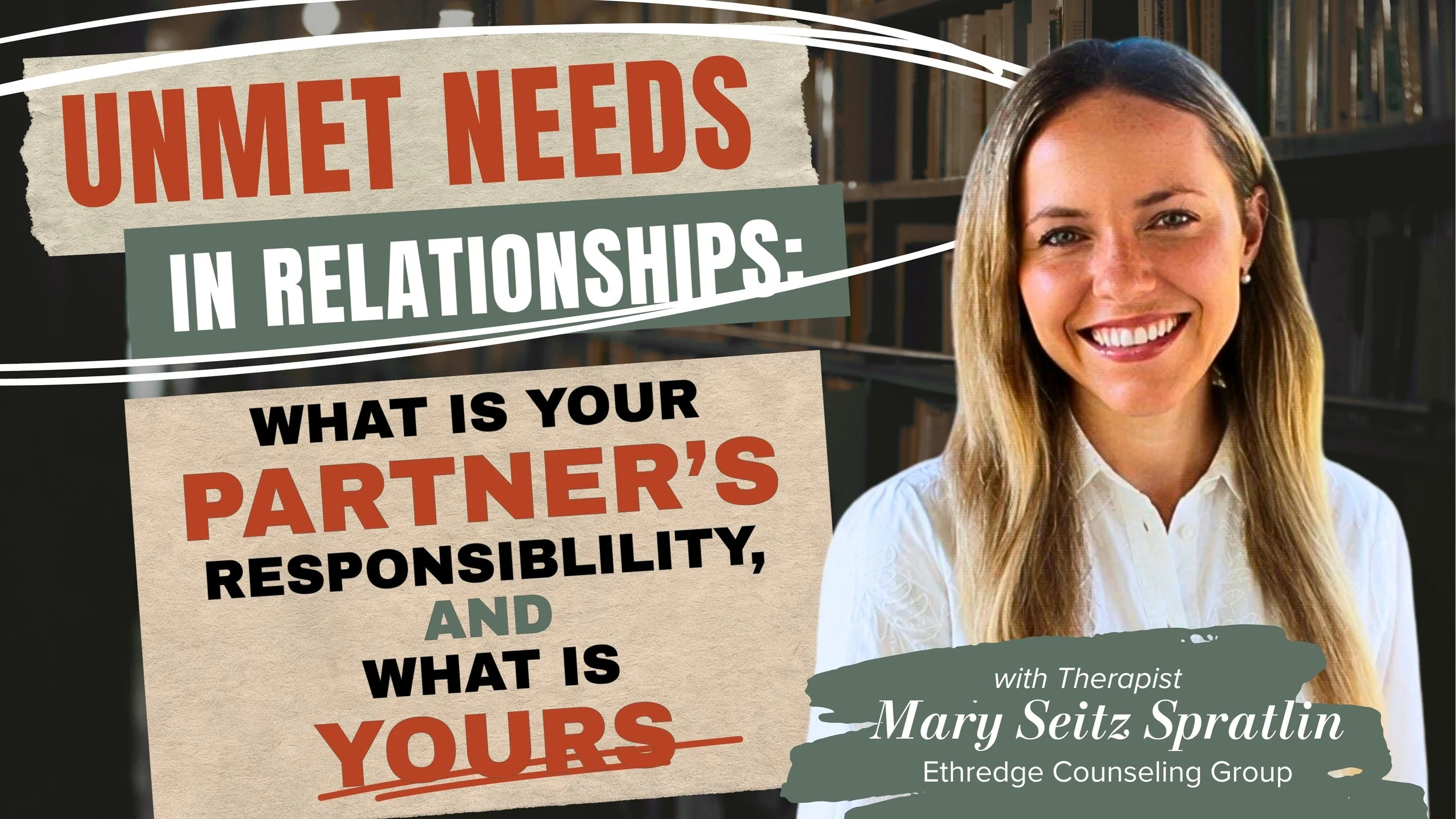
Unmet Needs in Relationships: What Is Your Partner’s Responsibility, And What Is Yours?
Sometimes resentment in a relationship is a sign that something needs to be talked about.
But sometimes, before we take that resentment to our partner, we need to sit with it ourselves.
We might feel frustrated by the things our partner isn't doing, the ways they aren't showing up, or the needs they aren't meeting.
Some of those feelings may be completely valid. But it can be helpful to pause and ask ourselves some harder questions.
Have I actually told my partner what I need, or have I been hoping they'll figure it out?
Am I expecting them to fill a role they were never meant to fill?
Am I asking one person to meet every emotional need I have?
What part of this disappointment belongs to my partner, and what part belongs to me?
These questions aren't meant to talk ourselves out of our feelings, they are meant to help us understand them.
Your Partner Can’t Meet Every Emotional Need
It is easy to put a lot of responsibility on our romantic relationships.
We want our partner to make us feel loved, secure, understood, supported, and okay.
The hard truth, though, is that a relationship isn't meant to make us whole.
Our partner can love us deeply and still disappoint us. They can support us without being responsible for our emotional wellbeing. They can meet many of our needs without being capable of meeting all of them.
There are things we have to learn to give ourselves.
Sometimes we need to build a fuller life outside of our relationship. We need friendships, interests, purpose, rest, self-trust, and ways of caring for ourselves that don't depend entirely on whether our partner is having a good day or giving us the reassurance we want.
Before You Blame Your Partner, Look at What’s Yours
As much as we try, we can't convince or control our partner into becoming the person we want them to be. At some point, we have to turn our attention back toward ourselves and sit with some hard questions.
How am I showing up?
Am I communicating clearly?
Am I taking responsibility for my reactions?
Am I holding onto a list of disappointments that I haven't actually talked about?
Am I expecting something from my partner that I need to learn how to provide for myself?
Looking inward isn't the same as blaming ourselves.
It is recognizing where our power actually is.
What Changes When You Focus on Your Own Growth?
Imagine what could happen if we spent less energy trying to get our partner to change and more energy becoming the person we want to be in our relationship.
What if we worked on becoming more honest about our needs instead of expecting them to guess?
What if we learned how to soothe ourselves instead of needing them to make everything feel okay?
What if we focused on being a partner we are proud to be?
This doesn't mean we stop asking for what we need. It doesn't mean we excuse behavior that hurts us or stay in relationships that aren't healthy.
It means we stop confusing our responsibility with someone else's.
We can love our partners deeply without making them responsible for our happiness. We can want more from our relationships without expecting another person to fill every empty place inside of us.
And sometimes, the healthiest question we can ask isn't, “How do I get my partner to change?”
It is, “What is mine to work on here?”
Because we may not be able to control what our partner chooses.
But we can always begin with ourselves.
Interested in working with ECG?
Schedule a free 15min consult to get started!