

The ECG Blog

Why Do We Keep Having the Same Fight? An EFT Perspective
If you've been in a relationship for any amount of time, you probably know what it's like to have the same argument more than once.
Maybe it starts with something small.
One person didn't do something they said they would do. Someone came home later than expected. One of you wanted to spend time together and the other wanted some time alone.
And then, somehow, you're having that argument again.
I've had many couples tell me some version of, “We don't even know how we get here. We start talking about one thing, and suddenly we're fighting about everything.”
From an Emotionally Focused Therapy (EFT) perspective, there is often a reason for this.
The problem isn't necessarily the topic you're arguing about. More often, it's the pattern the two of you get pulled into.
The Pattern Becomes the Problem
Sue Johnson, the founder of EFT and author of Hold Me Tight, describes these patterns as negative cycles.
One partner says something, the other reacts, and then the first person reacts to that reaction. Before long, both people are upset and neither feels understood.
One partner feels disconnected and reaches for the other. They may ask questions, bring up the problem repeatedly, or become frustrated because they aren't getting the response they're looking for.
The other partner feels overwhelmed by the conversation and pulls back. They get quiet, leave the room, or try to end the conversation.
Unfortunately, this usually makes the first partner even more anxious. They pursue harder, which makes the other person want to get away even more.
This leaves you both feeling stuck with neither of you getting what you actually want.
There's Usually More Going On
One of the things I appreciate about EFT is that it asks us to look underneath the behavior.
The partner who is asking, “Why don't you ever talk to me?” may actually be asking, “Do I matter to you?”
The partner who says, “I can't do this right now,” may actually be feeling, “I'm afraid I'm going to make this worse. I don't know how to make you happy.”
Those are very different conversations.
So How Do You Get Out of It?
The first step isn't necessarily learning to communicate better.
It's learning to recognize your cycle.
I often encourage couples to start noticing what happens right before things fall apart.
Who reaches for the other person?
What does that look like?
What happens next? What do you tell yourself about your partner's reaction?
And, perhaps most importantly, what are you feeling underneath your frustration?
You may discover that your anger is covering hurt. Or that your silence is covering fear. Or that your criticism is really a desperate attempt to feel important to your partner.
Once you can see the pattern, you can start talking about the pattern instead of just fighting about whatever happened that day.
Sometimes simply being able to say, “I think we're doing our thing again,” can change the direction of a conversation.
You Don't Have to Stop Fighting
I don't think healthy relationships are relationships where couples never argue.
You're going to disagree.
You're going to annoy each other.
You're going to have days when you don't understand each other very well.
The difference is whether you can find your way back to one another.
The goal isn't perfection.
It's learning to recognize when the two of you are getting pulled into a cycle and remembering that your partner isn't the enemy.
The cycle is the problem.
And once you start seeing it that way, there's an opportunity to do something different.
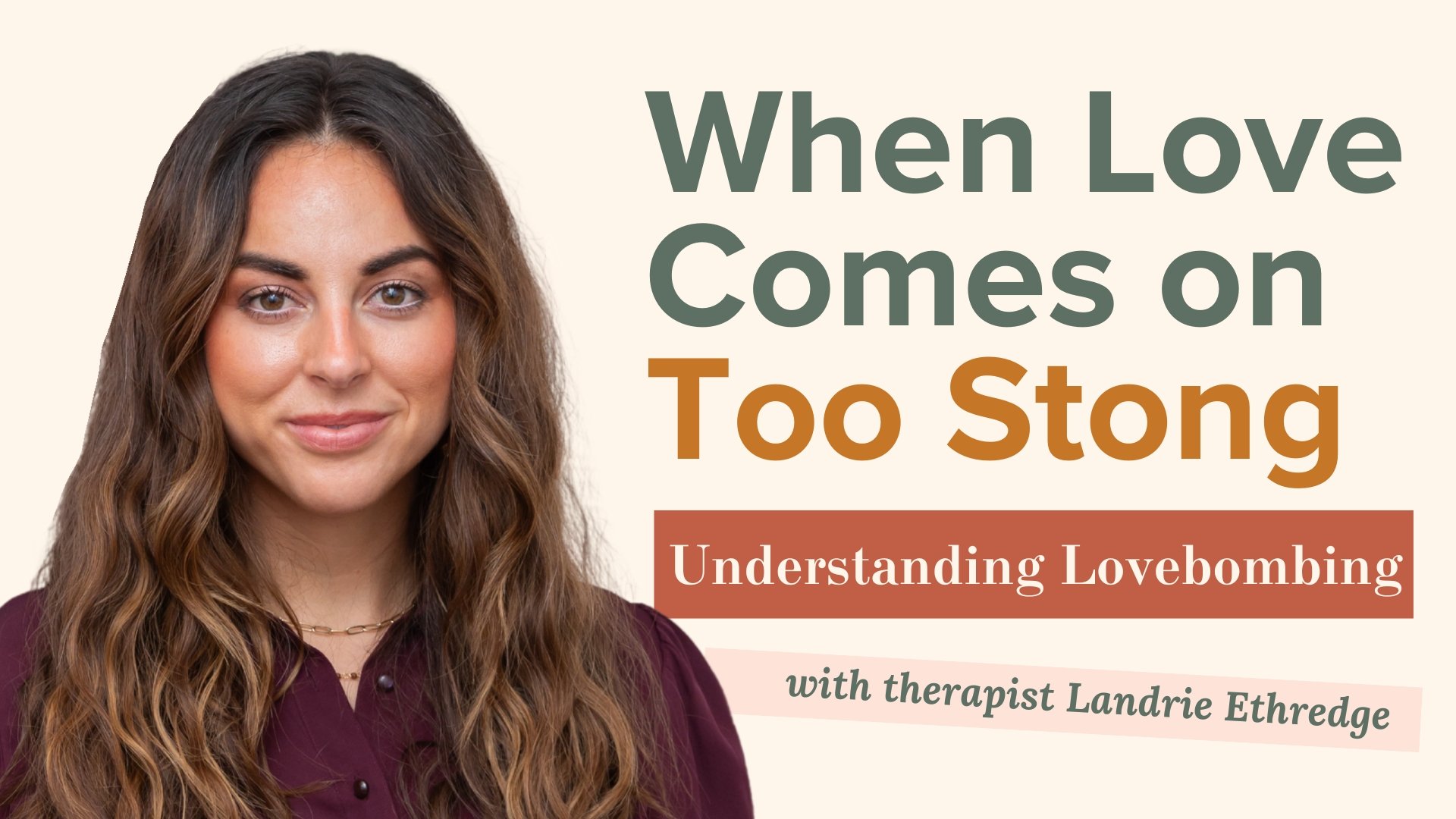
When Love Comes on Too Strong: Understanding Love Bombing
If you've spent any time on social media lately, you've probably seen the term "love bombing" - usually painted as something calculated. A red flag. A manipulation tactic.
And sometimes, it is.
But here's what often gets missed: love bombing is frequently UNINTENTIONAL. It's subconscious. And believe it or not, it usually comes from a genuinely well-intentioned place - a deep desire to connect with someone.
The problem? Good intentions can still create harmful dynamics.
What Love Bombing Actually Is
Love bombing is an overwhelming rush of affection, attention, and intensity early in a relationship (or during a season of reconnection). Constant texts. Grand gestures. Declarations of deep feelings before the relationship has had time to grow roots.
On the surface, it can feel wonderful. Who doesn't want to feel adored?
But underneath all that intensity, love bombing is a SUBSTITUTE for something. A sbustitue for true, safe intimacy, and emotional connection. It's not built on knowing someone deeply. It's built on insecurity and idealized love. The person love bombing isn't trying to manipulate; they're trying to secure connection the only way they know how. By flooding the relationship with intensity and hoping it sticks.
Real intimacy takes time, vulnerability, and the willingness to be truly seen. Love bombing skips all of that and tries to manufacture closeness overnight.
The Pendulum Swing
Here's where the dynamic gets painful for everyone involved.
When all that intensity doesn't create the connection the person is longing for, when the other person pulls back, needs space, or simply can't match the pace, the pendulum swings. Hard.
The person who was showering you with affection may suddenly withdraw. Go cold. Pull away entirely. Maybe eve disappears completely. This isn't punishment (though it can feel that way). It's another attempt to create emotional safety, this time by protecting themselves from the rejection they fear is coming.
So the relationship swings back and forth: intense pursuit, then retreat. Closeness, then distance. And neither person ever lands in the middle, the place where safe, steady connection actually lives.
If you're on the receiving end, this whiplash is confusing and destabilizing. You start wondering what you did wrong. If you're the one swinging, you're exhausted and hurting too, wondering WHY connection always seems to slip through your fingers.
Compassion for Both Sides
If you recognize yourself as the love bomber, please hear this: you are not a bad person. You're likely someone who wants connection so deeply that the wanting itself gets in the way. That's worth exploring, not shaming.
And if you're on the receiving end, your pain is oh-so valid. Feeling overwhelmed by intensity doesn't make you cold or unloving. It often means your nervous system is telling you the pace isn't safe yet.
Healthy love doesn't need to rush. It doesn't flood or withdraw. It builds. Slowly, steadily, with room for both people to breathe.
Some Questions to Sit With
Wherever you find yourself in this dynamic, I'd invite you to reflect:
When I feel disconnected from someone I care about, what's my first instinct? To pursue harder, or to pull away?
Do I trust that I'm lovable at a normal pace, without the grand gestures?
Have I ever mistaken intensity for intimacy?
What would it feel like to let a relationship unfold slowly? And could I tolerate that?
There are no wrong answers here. Just information about your patterns, your fears, and what you're really longing for underneath it all.
Because at the end of the day, love bombing isn't about too much love. It's about not yet knowing how to feel safe in it.

Unraveling Anxiety and Attachment Styles
Anxiety is an emotion that can affect anyone, regardless of age, gender, or background. However, when it comes to understanding and managing anxiety, one's attachment style plays a significant role, particularly for women. Attachment styles influence how we connect with others, process emotions, and handle stress. In this blog post, we'll explore the intricate relationship between anxiety and attachment styles, offering insights and strategies for women to better navigate their emotional landscapes.
Understanding Attachment Styles
Attachment theory, developed by John Bowlby and later expanded upon by Mary Ainsworth, helps us comprehend the way we form emotional bonds with others. Attachment styles typically fall into four categories: secure, anxious-preoccupied, dismissive-avoidant, and fearful-avoidant (also known as disorganized). These styles are formed in childhood based on our early experiences with caregivers and continue to impact our relationships throughout our lives. It is important to note that these categories are fluid, rather than rigid, meaning that your attachment style may have components that have characteristics of several styles.